Towel Folding
WoVR+
SFT
Videos shown at 2× speed.
WoVR+ retains WoVR’s core premise: controlling hallucination enables reliable policy optimization in imagination.
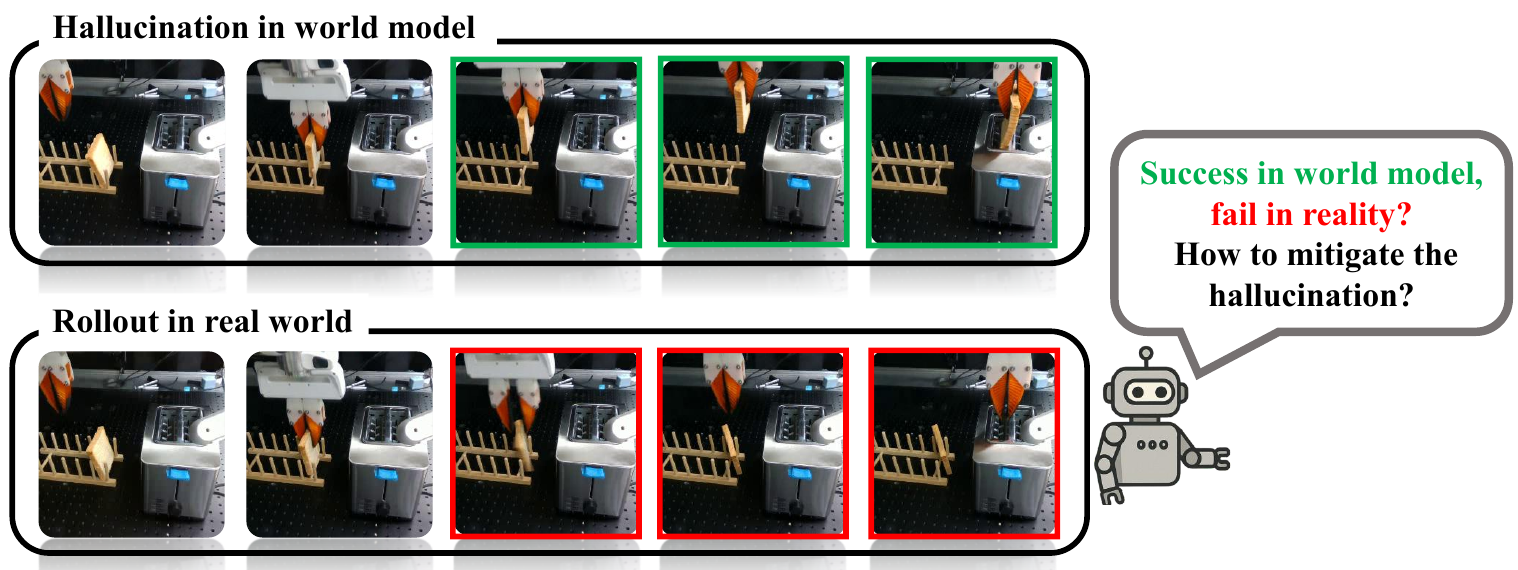
ACWMs may generate visually plausible yet physically incorrect rollouts, resulting in spurious success signals under the policy’s actions.
If world models inevitably hallucinate, how can RL remain reliable under imperfect imagined dynamics?
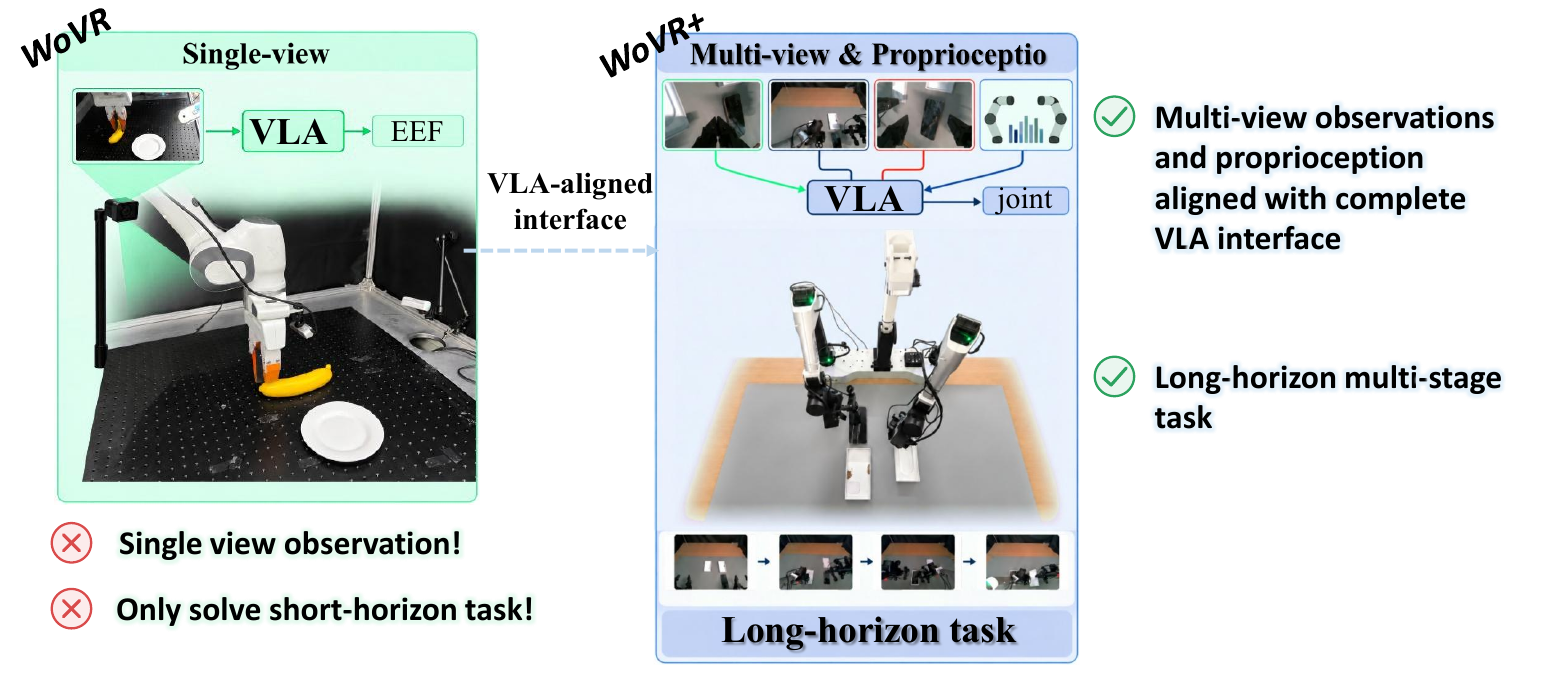
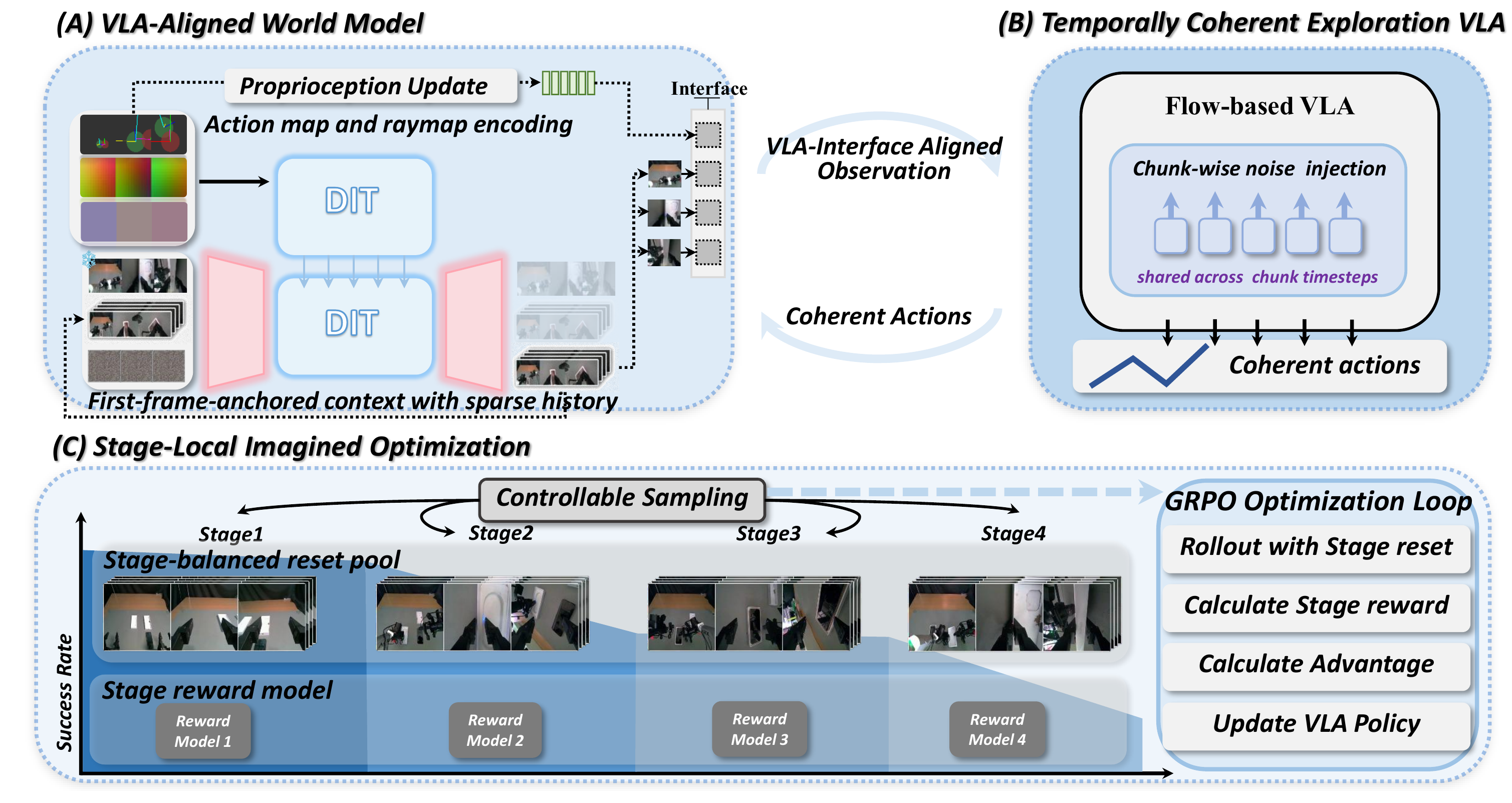
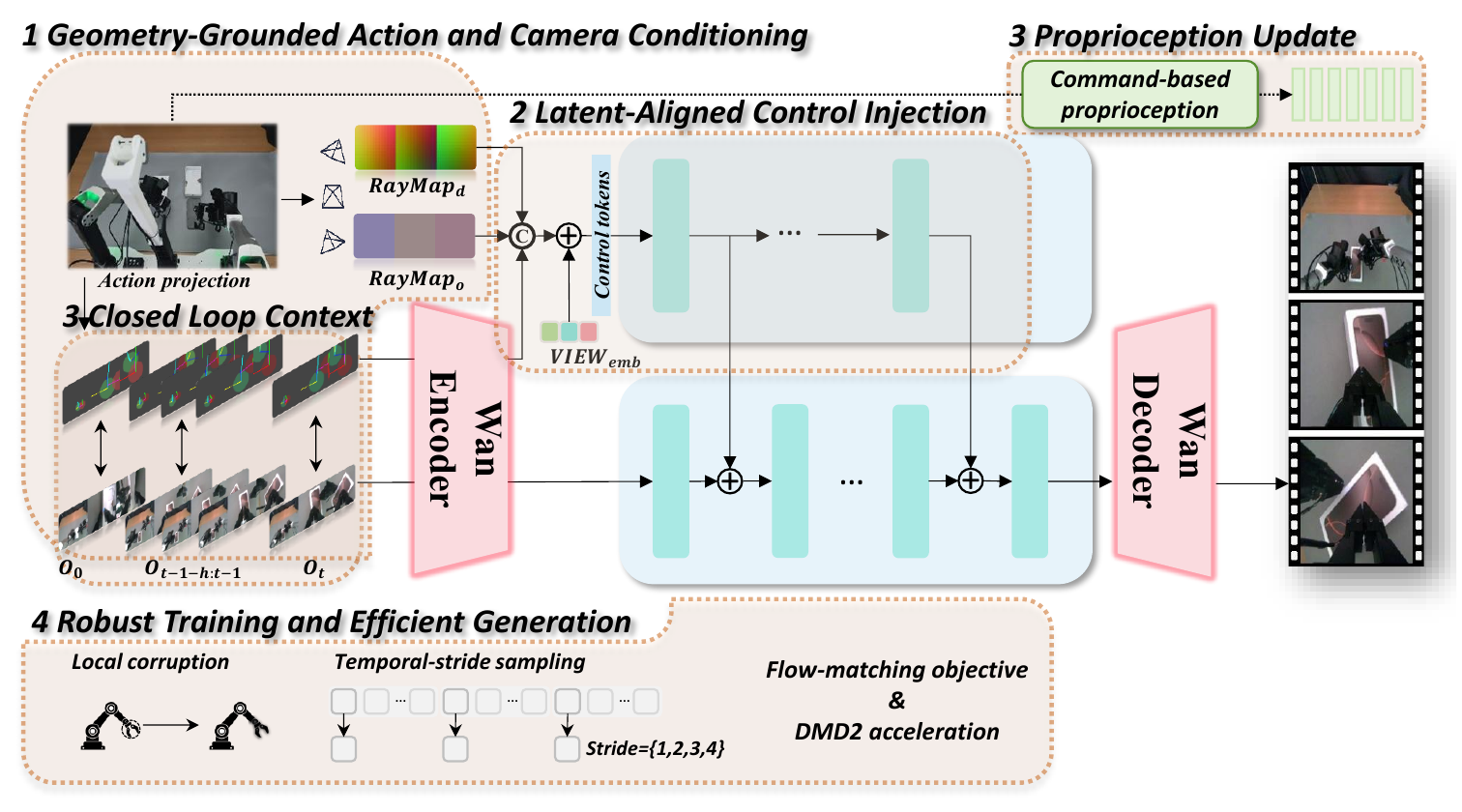
Modern VLAs require temporally, spatially, and cross-modally consistent multi-view observations and proprioception. Exploration-induced action jitter can degrade world-model predictions, while autoregressive errors accumulate over long-horizon, multi-stage tasks. Reliable WM-RL must therefore align the interaction interface, preserve effective exploration, and organize stage-wise learning.
WoVR treats the world model as a generative simulator and controls hallucination at three complementary levels: simulator-level control, interaction-level reshaping, and policy-model alignment.
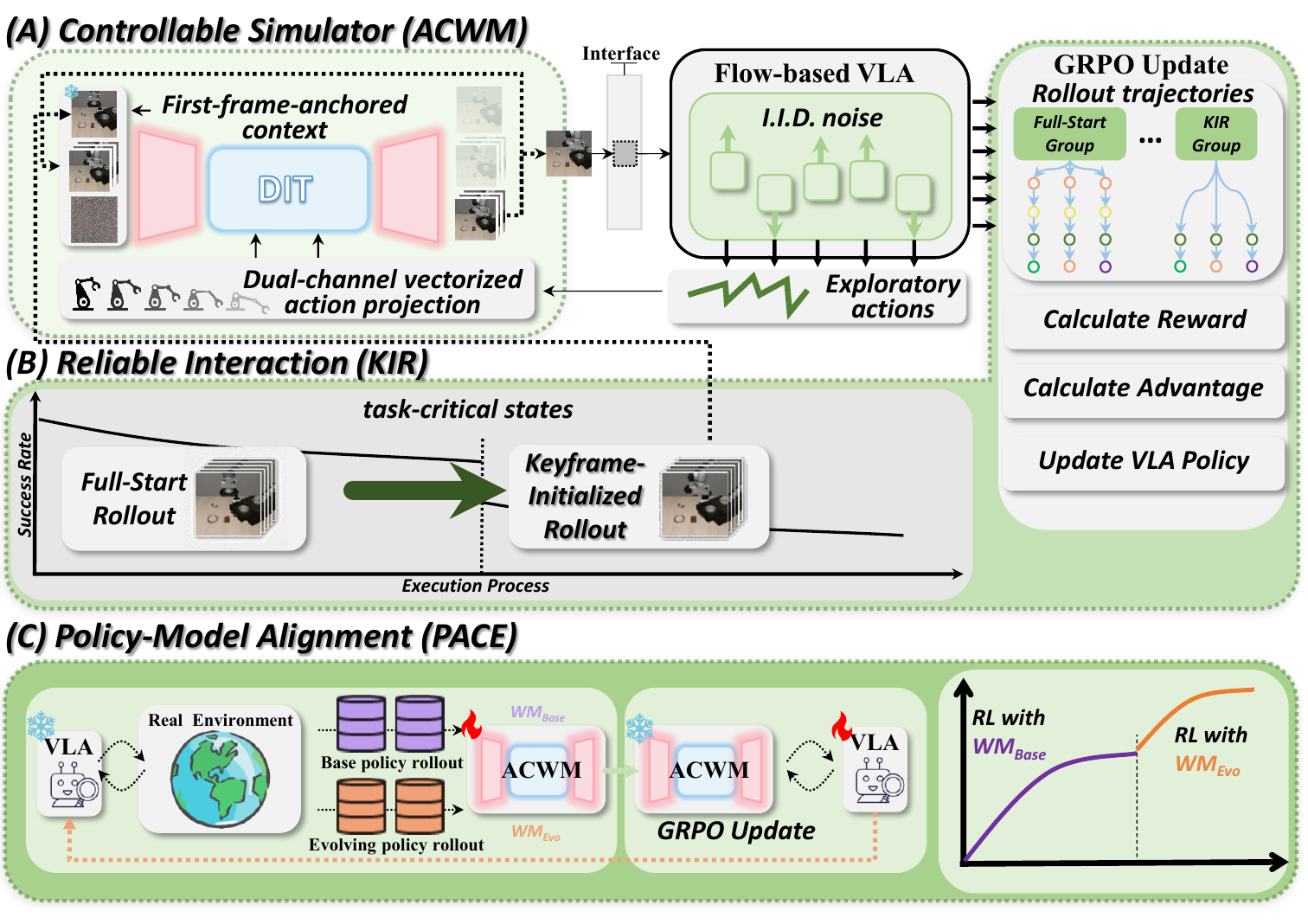
WoVR+ preserves this reliability-oriented framework while redesigning its learned environment, exploration, and imagined interaction protocol for multi-view VLA policies and long-horizon, multi-stage manipulation.
| Method | NFE | Head View | Wrist Views | FPS↑ | ||||||||
|---|---|---|---|---|---|---|---|---|---|---|---|---|
| LPIPS↓ | FID↓ | FVD↓ | SSIM↑ | PSNR↑ | LPIPS↓ | FID↓ | FVD↓ | SSIM↑ | PSNR↑ | |||
| Ctrl-World | 5 | 0.318 | 73.22 | 229.83 | 0.812 | 16.39 | 0.350 | 117.45 | 305.39 | 0.863 | 22.38 | 4.16 |
| Ctrl-World | 50 | 0.305 | 47.16 | 147.46 | 0.802 | 15.86 | 0.346 | 73.67 | 186.66 | 0.849 | 22.14 | 0.53 |
| EVAC | 27 | 0.337 | 50.93 | 196.72 | 0.768 | 13.76 | 0.328 | 68.49 | 185.15 | 0.833 | 20.89 | 1.71 |
| WoVR (1 view) | 5 | 0.182 | 20.74 | 75.09 | 0.858 | 19.12 | – | – | – | – | – | 22.56 |
| WoVR (3 views) | 5 | 0.231 | 27.01 | 109.33 | 0.825 | 16.96 | 0.269 | 47.55 | 124.41 | 0.825 | 23.16 | 14.01 |
| WoVR+ | 5 | 0.148 | 22.45 | 62.16 | 0.883 | 22.28 | 0.204 | 44.10 | 81.33 | 0.894 | 29.77 | 9.41 |
| WoVR+ | 50 | 0.153 | 19.92 | 49.61 | 0.877 | 21.86 | 0.203 | 35.96 | 65.77 | 0.888 | 29.39 | 1.78 |
| WoVR+ (DMD) | 1 | 0.163 | 23.59 | 57.41 | 0.877 | 22.20 | 0.236 | 53.58 | 106.15 | 0.889 | 28.79 | 15.03 |
Wrist metrics are averaged over the two wrist cameras. Best and second-best quality scores are shown in bold and underlined, respectively. “–” denotes an unavailable view. NFE: number of function evaluations; FPS: generated frames per second.
We evaluate two VLA policies on each of three tasks, with 120 real-robot and 120 imagined rollouts per task–policy pair. Each imagined rollout uses the initial images from its corresponding real-robot rollout. Success rates are strongly correlated across the six task–policy pairs (Pearson r = 0.970; Spearman ρ = 0.943).
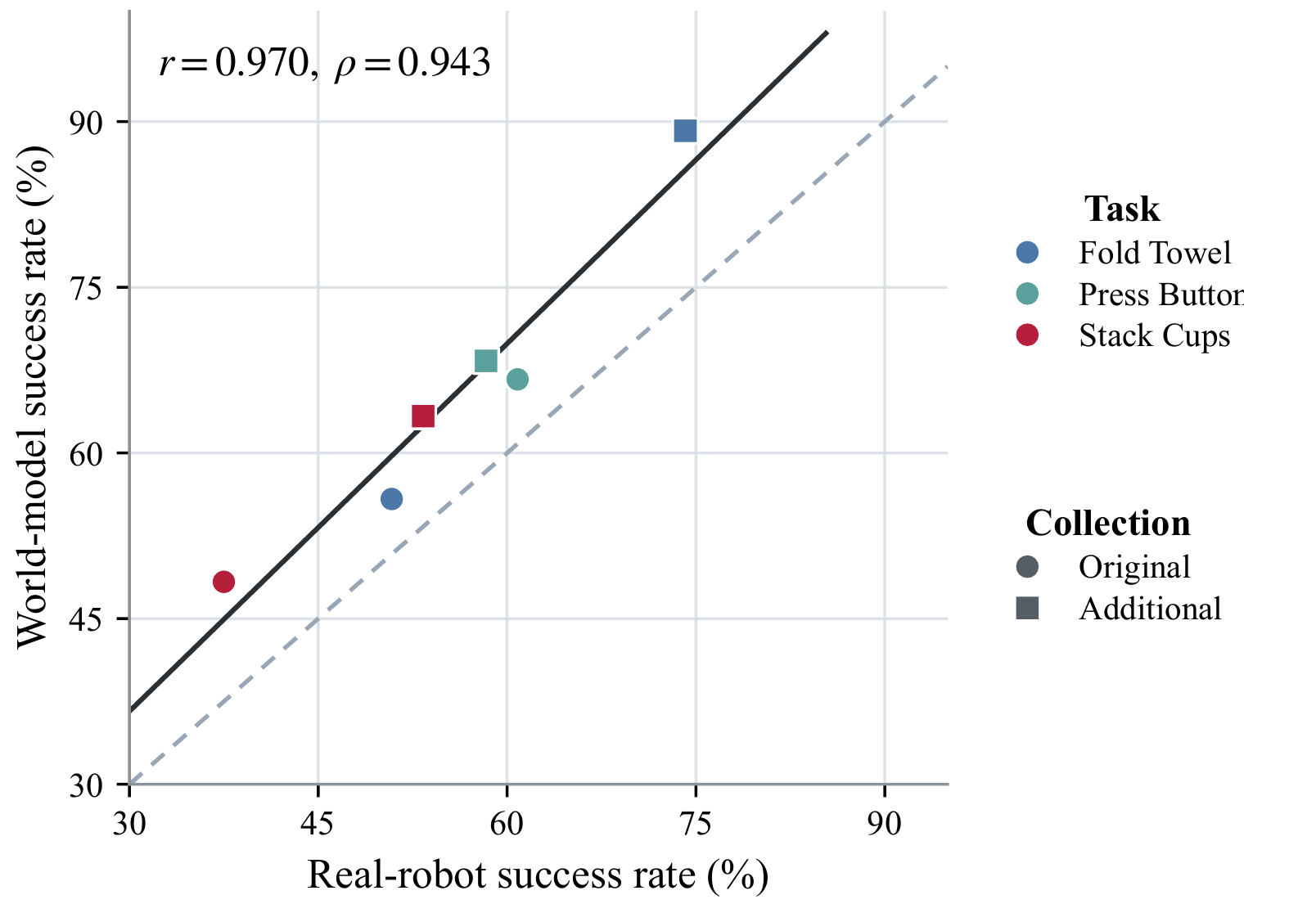
Colors denote tasks; circles and squares distinguish the original and additional collections.
Using 500 environment rollouts to train the world model, we generate 512 synthetic trajectories from matched reset states. Success filtering retains 401 real and 480 synthetic trajectories for continued SFT. WM-BC improves success from 71.00% to 91.00% under fixed resets and from 72.66% to 76.56% under randomized resets. Filtered synthetic demonstrations provide useful but incomplete supervision, motivating direct WM-RL over both successful and failed rollouts.
| Exploration | Updates | Adjust Bottle | Click Bell | ||
|---|---|---|---|---|---|
| Fixed | Random | Fixed | Random | ||
| Initial SFT | 0 | 79.00 | 70.70 | 71.00 | 72.66 |
| Chunk-wise | 10 | 76.00 | 76.95 | 87.00 | 81.25 |
| Chunk-wise | 20 | 80.00 | 80.86 | 89.00 | 86.72 |
| Chunk-wise | 30 | 85.00 | 86.33 | 87.00 | 86.33 |
| Chunk-wise | 40 | 86.00 | 88.28 | 88.00 | 89.45 |
| Chunk-wise | 50 | 93.00 | 91.80 | 92.00 | 93.75 |
| I.I.D. | 10 | 72.00 | 65.63 | 78.00 | 75.78 |
| I.I.D. | 20 | 73.00 | 77.34 | 71.00 | 68.36 |
| I.I.D. | 30 | 77.00 | 78.52 | 72.00 | 74.22 |
| I.I.D. | 40 | 70.00 | 68.36 | 81.00 | 74.61 |
| I.I.D. | 50 | 77.00 | 74.22 | 89.00 | 86.33 |
Fixed evaluation uses 100 shared initial states. The initial policy, world model, reward model, rollout budget, and GRPO configuration are held constant.
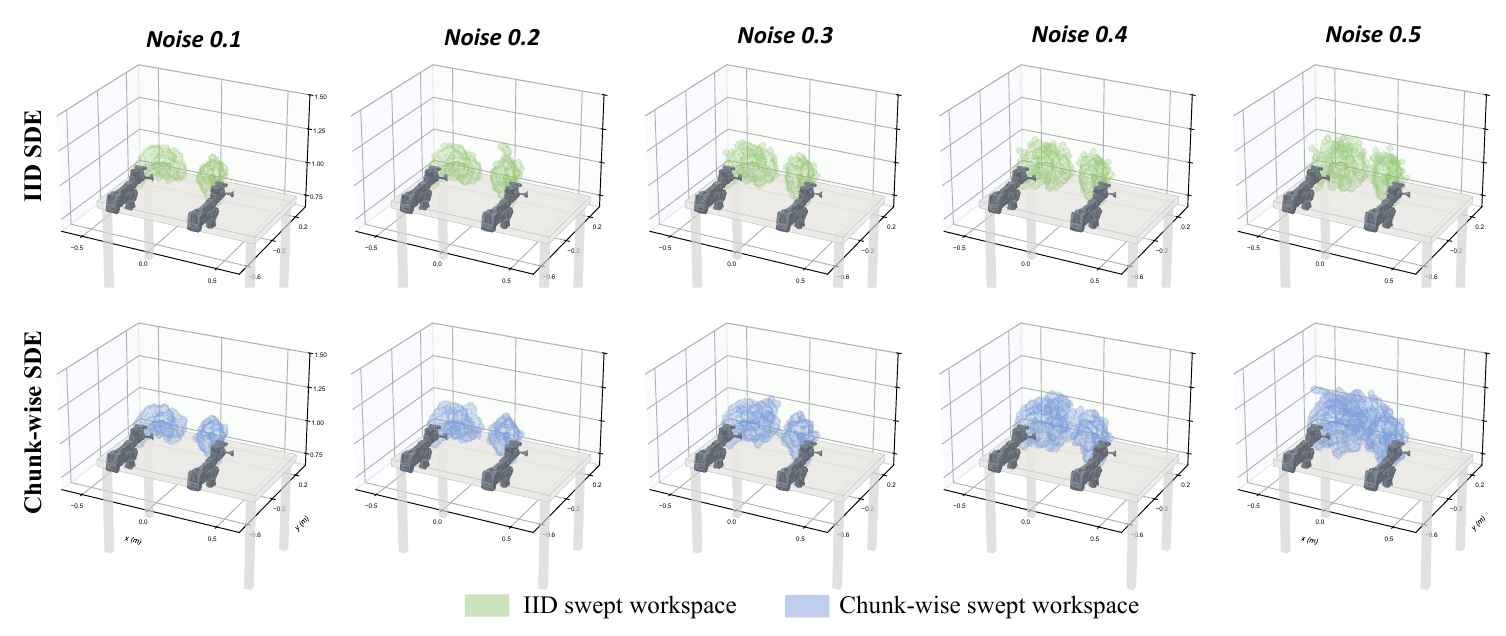
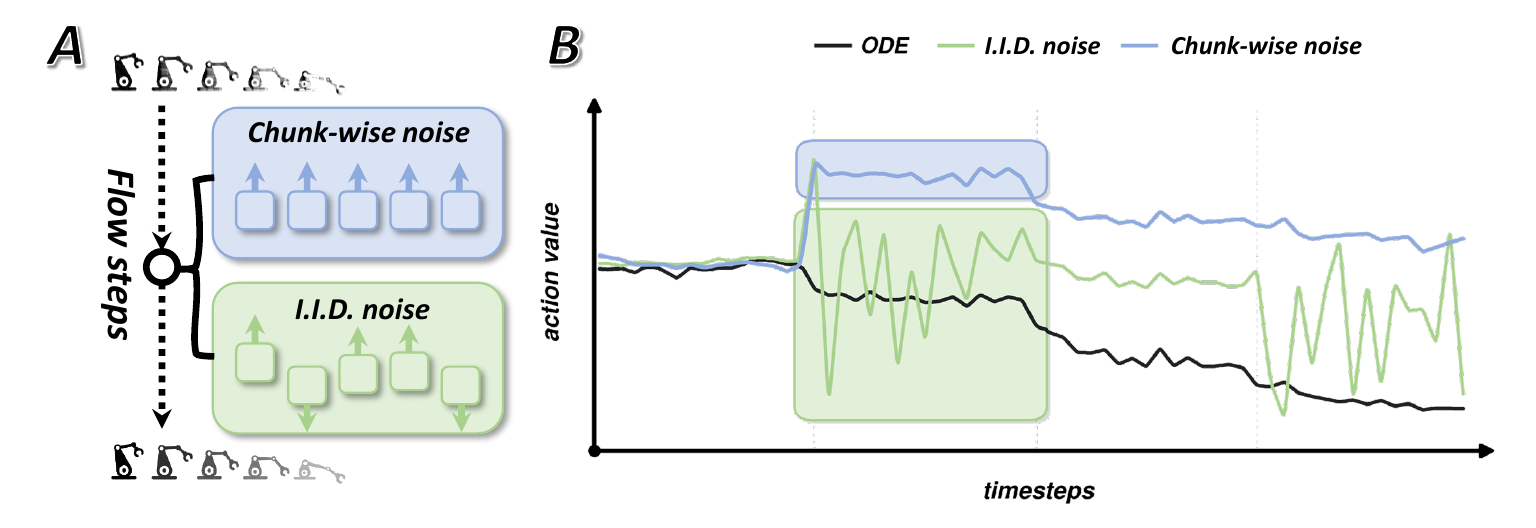
Chunk-wise exploration achieves higher final success rates in both tasks and both evaluation settings. At larger noise scales, it also produces broader executed EEF coverage, turning exploratory perturbations into coherent motion rather than high-frequency fluctuations.
| RL Environment | Adjust Bottle | Click Bell | ||
|---|---|---|---|---|
| Fixed | Random | Fixed | Random | |
| Single-view VLA | ||||
| None (SFT) | 68.00 | 58.98 | 59.00 | 40.63 |
| Direct RL (matched) | 69.00 | 60.16 | 60.00 | 37.89 |
| Direct RL (converged) | 78.00 | 76.95 | 89.00 | 83.59 |
| WoVR | 69.00 | 63.67 | 77.00 | 68.36 |
| WoVR+ (1 view) | 75.00 | 71.09 | 85.00 | 73.44 |
| Multi-view VLA | ||||
| None (SFT) | 79.00 | 70.70 | 71.00 | 72.66 |
| Direct RL (matched) | 74.00 | 68.75 | 82.00 | 79.30 |
| Direct RL (converged) | 95.00 | 94.53 | 99.00 | 98.83 |
| Ctrl-World | 79.00 | 76.56 | 84.00 | 78.52 |
| WoVR (3 views) | 90.00 | 83.20 | 92.00 | 90.63 |
| WoVR+ | 93.00 | 91.80 | 92.00 | 93.75 |
Fixed: 100 shared initial states; Random: 256 random states. Direct RL (matched) uses a matched online-interaction budget; Direct RL (converged) is trained without that budget constraint.
WoVR+ improves policy performance on both RoboTwin tasks and outperforms budget-matched Direct RL under both view configurations, approaching the unconstrained converged baseline.
After 50 WM-RL updates with no further real-robot data collection, success improves on all six tasks. The average rises from 39.2% to 55.8%.
| Training variant | Stage 1 | Stage 2 | Stage 3 | Stage 4 |
|---|---|---|---|---|
| SFT | 100.0%20/20 | 50.0%10/20 | 70.0%7/10 | 85.7%6/7 |
| Full-start+ traj reward | 100.0%20/20 | 55.0%11/20 | 100.0%11/11 | 90.9%10/11 |
| Full-start+ stage reward | 100.0%20/20 | 90.0%18/20 | 88.9%16/18 | 68.8%11/16 |
| KIR(Stage4-only) | 90.0%18/20 | 72.2%13/18 | 76.9%10/13 | 100.0%10/10 |
| Stage-reset+ arrival-matched | 100.0%20/20 | 90.0%18/20 | 100.0%18/18 | 22.2%4/18 |
| Stage-reset+ uniform | 100.0%20/20 | 85.0%17/20 | 94.1%16/17 | 93.8%15/16 |
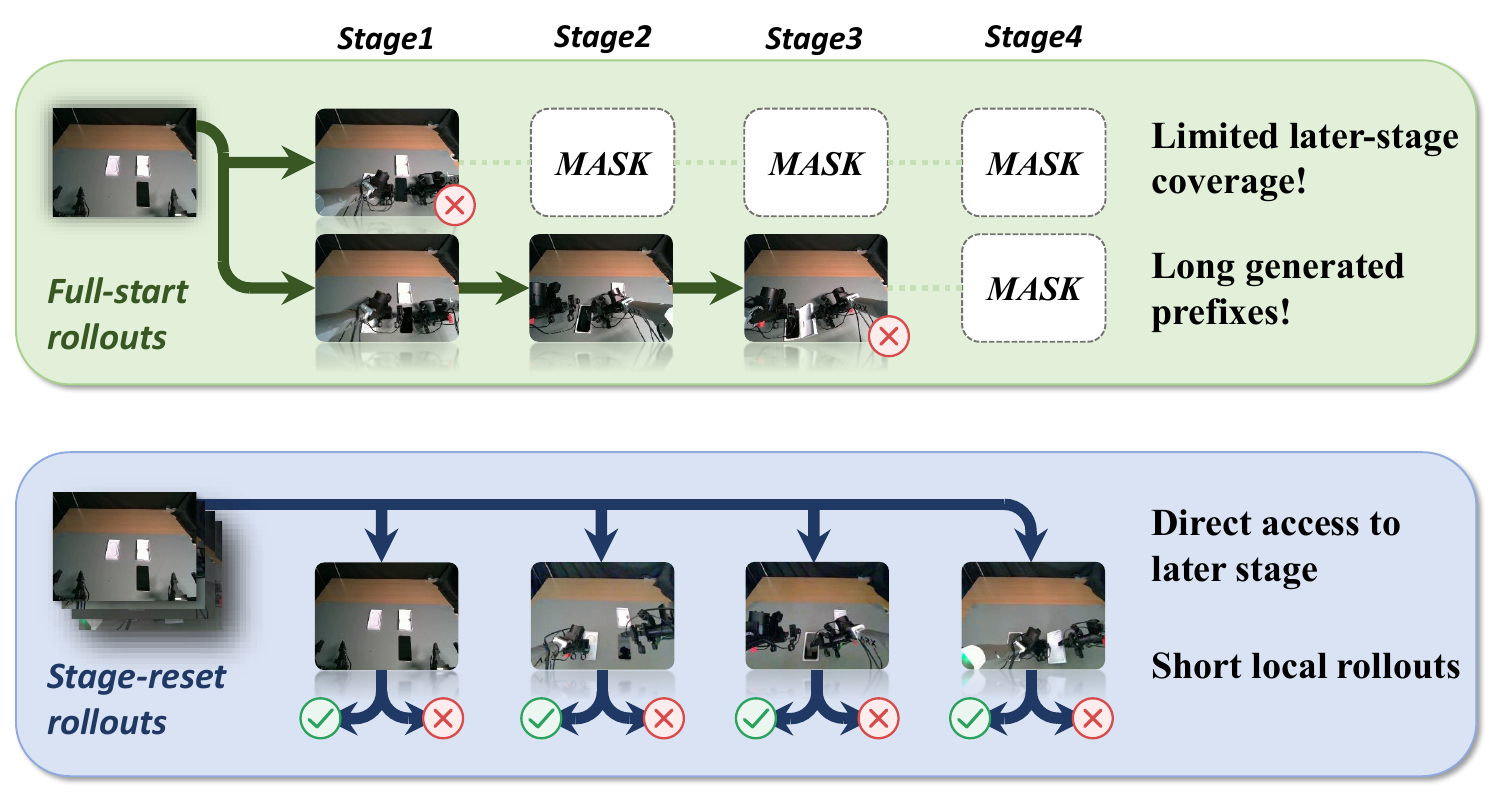
Uniform stage-reset training reaches 75% end-to-end success (15/20), compared with 30% for SFT, 50% for full-start training with trajectory rewards, and 55% with stage-wise rewards. Arrival-matched stage sampling reaches only 20%, highlighting the importance of balanced training opportunities across stages.
Action-conditioned world models can reduce costly real-robot interaction in reinforcement learning for Vision-Language-Action models (VLA-RL), but hallucinations can mislead policy optimization. Extending them to richer VLA interfaces and long-horizon tasks raises challenges in spatiotemporal and cross-modal consistency, exploration–reliability balance in RL, and compounding rollout errors.
We present WoVR+, extending WoVR’s hallucination-aware WM-RL framework by redesigning the learned environment and imagined interaction protocol: A VLA-interface-aligned world model provides multi-view prediction and proprioceptive updates while mitigating hallucinations. Chunk-wise noise preserves flow-based policy exploration while limiting prediction-degrading action jitter. For long-horizon tasks, stage-local imagined training combines stage-entry resets, stage-specific rewards, local horizons, and controllable sampling to shorten generated prefixes and balance training across stages.
WoVR+ improves success over SFT by 21.09% and 16.7% on RoboTwin and 6 real-robot tasks. Long-horizon phone-packaging success rises from 30% to 75%.
Ground-truth (GT) videos on the left; WoVR+ world-model predictions on the right, replaying the same recorded actions from the same initial observation.
Head, left wrist, and right wrist views, top to bottom. Videos shown at 2× speed.